
Introduction
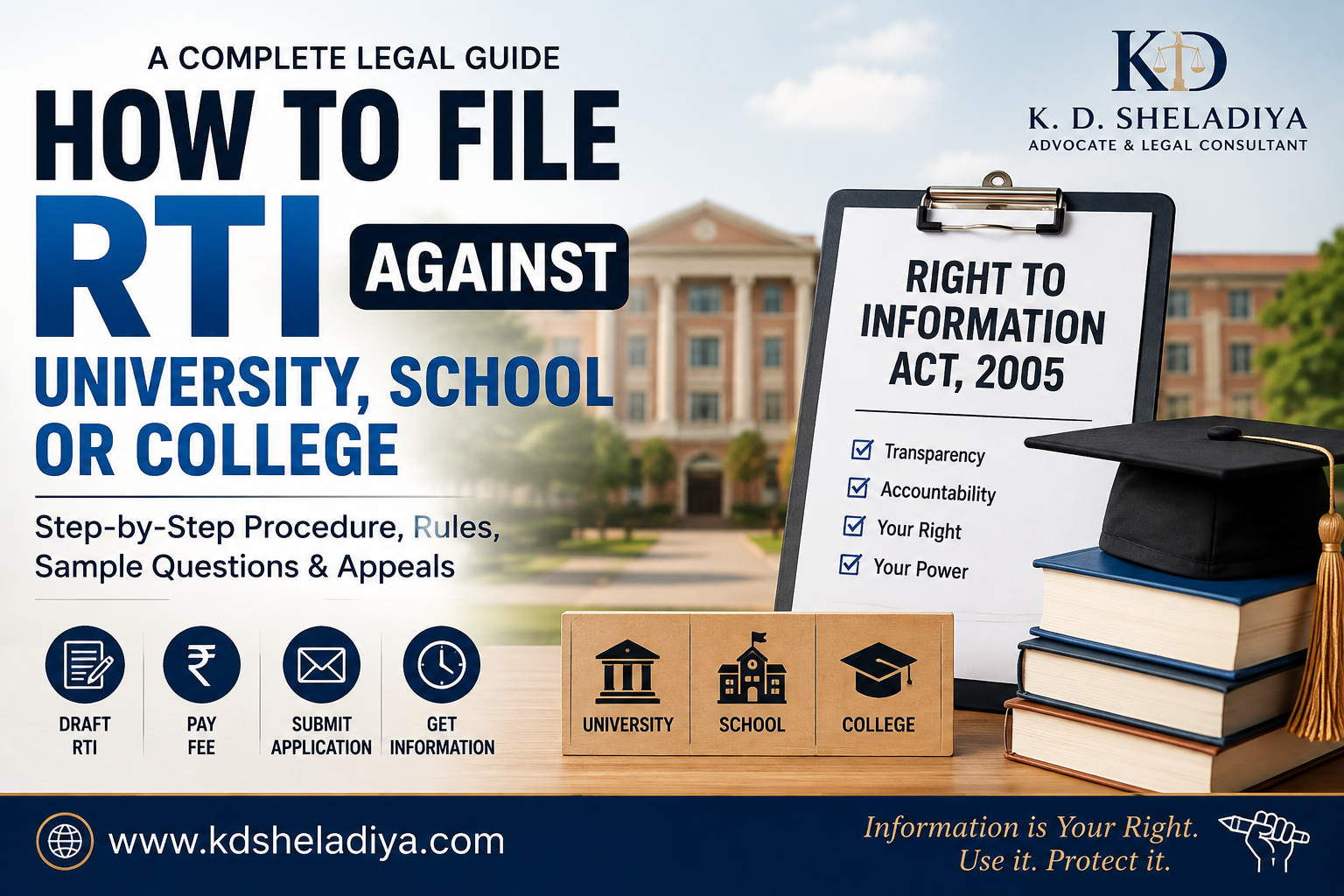
Access to information is a fundamental pillar of transparency and accountability in a democratic society. The Right to Information Act, 2005 (RTI Act) empowers every Indian citizen to seek information from public authorities, including government educational institutions and, in certain circumstances, private educational institutions.
Students, parents, researchers, and citizens often face situations where educational institutions refuse to provide information relating to admissions, examinations, recruitment, fee structures, scholarships, or affiliation. In such cases, filing an RTI application can be an effective and legally recognized remedy.
This guide explains when an RTI can be filed against a university, school, or college, the legal provisions involved, the filing procedure, and practical tips to ensure success.
What is the Right to Information (RTI)?
The Right to Information Act, 2005 was enacted to promote transparency and accountability in the functioning of public authorities.
Section 3 of the Act provides:
“Subject to the provisions of this Act, all citizens shall have the right to information.”
The Act enables citizens to obtain:
- Certified copies of official records
- Government orders
- Circulars and notifications
- Inspection reports
- Agreements and contracts
- Examination records
- Administrative decisions
- Financial records
- Recruitment documents
However, RTI only grants access to existing records. It does not compel authorities to create information, provide explanations, or answer hypothetical questions.
Can RTI Be Filed Against Educational Institutions?
The answer depends on the nature of the institution.
1. Government Universities
All Central and State Government Universities are public authorities under Section 2(h) of the RTI Act.
Examples include:
- Central Universities
- State Universities
- Agricultural Universities
- Technical Universities
- Open Universities
RTI applications can be filed directly with their Public Information Officer (PIO).
2. Government Schools
Government schools operated by:
- State Governments
- Municipal Corporations
- Panchayats
- Kendriya Vidyalayas
- Navodaya Vidyalayas
are covered under the RTI Act.
Information regarding admissions, appointments, grants, infrastructure, student welfare schemes, and utilization of funds may be sought.
3. Government Colleges
Government colleges maintained by State Governments or Central Government departments are public authorities and are directly answerable under the RTI Act.
4. Private Universities
Private universities require a separate legal analysis.
Many private universities are established under State legislation and discharge public educational functions. Depending upon the statutory framework and judicial interpretation, such universities may be treated as “public authorities” under the RTI Act.
Where a private university is not directly covered, information may still be obtained through the regulatory authority that supervises or controls it.
5. Private Schools and Colleges
Purely private educational institutions generally are not directly covered by the RTI Act.
However, information may often be obtained from authorities such as:
- University Grants Commission (UGC)
- AICTE
- National Medical Commission (NMC)
- Bar Council of India
- State Education Department
- Directorate of Higher Education
- State University
- School Education Board
If these authorities possess or can lawfully obtain the information, it can generally be sought through an RTI application.
Information You Can Obtain Through RTI
Educational institutions maintain extensive official records that are subject to disclosure unless exempted by law.
Some common categories include:
Admission Records
- Merit list
- Waiting list
- Admission policy
- Selection criteria
- Reservation roster
- Admission committee proceedings
- Cut-off marks
- Verification reports
Examination Records
Students frequently use RTI for examination-related issues.
Information may include:
- Certified copies of evaluated answer sheets
- Internal assessment marks
- Practical examination marks
- Moderation records
- Revaluation policy
- Attendance records
- Examination rules
Faculty Recruitment
Applicants may seek:
- Advertisement
- Eligibility criteria
- Selection committee minutes
- Appointment orders
- Educational qualifications
- Experience certificates
- Reservation compliance
Fee Structure
Parents often seek transparency regarding educational fees.
Information may include:
- Approved fee structure
- Fee fixation committee order
- Development fee utilization
- Building fund utilization
- Laboratory fee expenditure
Infrastructure
Information relating to:
- Fire Safety Certificate
- Building Safety Certificate
- Occupancy Certificate
- Laboratory approval
- Library facilities
- Hostel approvals
Affiliation and Recognition
You may request:
- Affiliation order
- Renewal order
- Inspection reports
- Compliance reports
- Recognition letters
- Accreditation documents
Scholarships
Students may seek:
- Scholarship disbursement records
- Beneficiary list
- Government grant utilization
- Pending scholarship applications
Information That Cannot Be Asked Under RTI
One of the most common mistakes is asking questions instead of seeking records.
Incorrect Questions
- Why was I failed?
- Why was my admission rejected?
- Why was another candidate selected?
- Why did the authority delay my application?
Such questions seek opinions or explanations.
Correct Questions
Instead, request existing records such as:
- Certified copy of my evaluated answer sheet.
- Certified copy of the Selection Committee proceedings.
- Certified copy of the merit list.
- Certified copy of the reasons recorded in the official file for rejection of my application.
- Copy of applicable rules governing admission.
Step-by-Step Procedure to File RTI
Step 1: Identify the Public Authority
Determine whether the institution is:
- Government School
- Government College
- Government University
- Central University
- State University
- Private University
- Affiliated College
Identify the designated Public Information Officer (PIO).
Step 2: Draft the RTI Application
Mention:
- Name of applicant
- Postal address
- Contact details (optional)
- Description of information sought
- Relevant department
- Relevant academic year
- Period to which information relates
Keep the application simple and specific.
Step 3: Pay the Prescribed Fee
Generally:
- ₹10 application fee
Additional charges may apply for:
- Photocopies
- CDs/DVDs
- Inspection beyond prescribed hours
Applicants falling below the poverty line (BPL) are exempt from payment upon submission of valid proof.
Step 4: Submit the Application
The RTI application may be submitted:
- Personally
- By Registered Post
- By Speed Post
- Through the online RTI portal (where available)
Always retain proof of submission.
Sample RTI Questions
Admissions
- Provide a certified copy of the admission merit list.
- Provide a certified copy of the waiting list.
- Provide a copy of the admission rules applicable for Academic Year 2026–27.
- Provide certified copies of the Admission Committee proceedings.
Examinations
- Provide certified copy of my evaluated answer sheet.
- Provide internal assessment marks.
- Provide moderation records.
- Provide attendance register for Semester IV.
Faculty
- Provide list of sanctioned teaching posts.
- Provide appointment orders of Assistant Professors.
- Provide educational qualifications of selected candidates.
Fees
- Provide approved fee structure.
- Provide details of development fee collected.
- Provide utilization statement of laboratory fees.
Infrastructure
- Provide Fire NOC.
- Provide Building Safety Certificate.
- Provide inspection report.
Time Limit for Reply
Under Section 7 of the RTI Act:
- Information should ordinarily be supplied within 30 days.
- If the application is transferred to another authority under Section 6(3), the transfer should be made within 5 days.
- In matters concerning life or liberty, information should be provided within 48 hours.
Failure to respond within the prescribed period is treated as a deemed refusal.
What If the Information Is Denied?
If the Public Information Officer refuses to provide information or fails to respond within the prescribed period, the applicant has statutory remedies.
First Appeal
A First Appeal may be filed before the designated First Appellate Authority within 30 days.
Second Appeal
If dissatisfied with the First Appeal decision, a Second Appeal may be filed before:
- Central Information Commission (CIC), or
- State Information Commission (SIC),
depending on the public authority concerned.
Practical Tips for Filing an Effective RTI
- Ask only for existing records.
- Mention the exact academic year or relevant period.
- Request certified copies wherever possible.
- Number each information request separately.
- Avoid lengthy narratives or arguments.
- Use clear, precise, and concise language.
- Retain copies of the RTI application and postal receipt.
Conclusion
The Right to Information Act, 2005 is a powerful legal mechanism that enables students, parents, teachers, and citizens to obtain official records from educational institutions and regulatory authorities. Whether the issue concerns admissions, examinations, fee structures, faculty appointments, infrastructure, or affiliation, a well-drafted RTI application can help ensure transparency and accountability.
Before filing, identify the correct public authority, frame your queries carefully, and request specific documents rather than explanations. If information is denied or delayed, the Act provides an effective appellate mechanism to protect your right to information.
By using the RTI Act responsibly and strategically, individuals can promote good governance, safeguard their legal rights, and contribute to greater transparency in the education sector.
