
Introduction
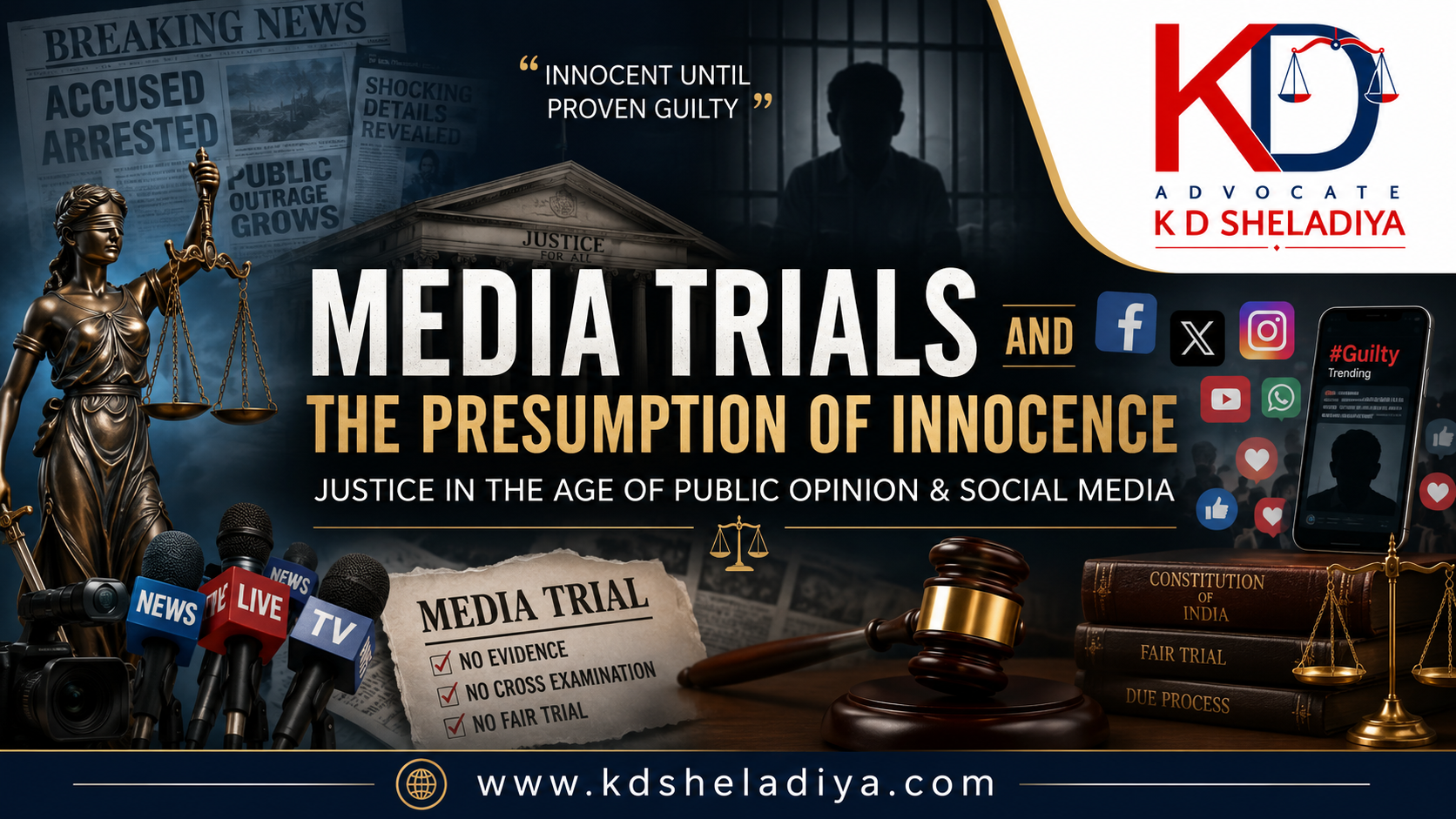
In today’s digital world, news no longer waits for tomorrow’s newspaper. Every criminal investigation, arrest, or allegation is instantly broadcast across television channels, online news portals, YouTube, X (formerly Twitter), Facebook, Instagram, and WhatsApp. Public opinion often forms within minutes—long before a court has examined the evidence.
This phenomenon, commonly known as a media trial, raises a critical constitutional question:
Can a person receive a fair trial when society has already declared them guilty?
The principle of “Presumption of Innocence” lies at the heart of every democratic criminal justice system. However, the growing influence of electronic media and social media often places this principle under severe strain.
This article examines the legal concept of media trials, their impact on criminal justice, relevant constitutional provisions, landmark judicial decisions, and the need to balance freedom of the press with the right to a fair trial.
What is a Media Trial?
A media trial refers to the situation where television channels, newspapers, digital platforms, or social media attempt to investigate, analyze, or even pronounce the guilt or innocence of an accused person before the court reaches its conclusion.
Unlike judicial proceedings, media discussions are often driven by:
- Public emotions
- Breaking news competition
- Political narratives
- TRP and online engagement
- Viral social media campaigns
As a result, the accused may be portrayed as guilty even before charges are proved.
Understanding the Presumption of Innocence
The principle of the Presumption of Innocence means:
Every accused person is presumed innocent unless proven guilty in accordance with law.
This principle protects individuals against arbitrary punishment and ensures that the prosecution bears the burden of proving guilt beyond reasonable doubt.
It is considered one of the most fundamental principles of criminal jurisprudence.
Constitutional Foundation in India
Although the Constitution does not expressly mention the presumption of innocence, it flows from several constitutional guarantees.
Article 21 – Right to Life and Personal Liberty
Article 21 guarantees that no person shall be deprived of life or personal liberty except according to procedure established by law.
The Supreme Court has interpreted Article 21 to include:
- Right to fair investigation
- Right to a fair trial
- Right to dignity
- Right to reputation
- Right against arbitrary conviction
When the media prejudges an accused, it may indirectly interfere with these rights.
Article 19(1)(a) – Freedom of Speech and Expression
The press enjoys freedom under Article 19(1)(a), enabling it to:
- Report crimes
- Criticize government actions
- Investigate public interest matters
- Inform citizens
However, this freedom is not absolute.
Under Article 19(2), reasonable restrictions may be imposed in the interests of:
- Contempt of court
- Defamation
- Public order
- Decency
- Morality
- Sovereignty and integrity of India
How Media Trials Affect Criminal Justice
Media trials can seriously undermine the administration of justice.
1. Prejudicing Public Opinion
Continuous media coverage creates a perception that the accused is guilty.
This social pressure may influence:
- Witnesses
- Investigating agencies
- Prosecutors
- Potential jurors (in jurisdictions with jury trials)
- General public
2. Impact on Fair Trial
Even judges, though trained to decide independently, function within society.
Excessive media attention can create indirect institutional pressure and affect the atmosphere surrounding a case.
3. Character Assassination
The media frequently publishes:
- Personal photographs
- Family details
- Social media posts
- Past conduct
- Unverified allegations
Even if acquitted later, the damage to reputation may be irreversible.
4. Pressure on Investigating Agencies
Public outrage, amplified by the media, may push police agencies toward:
- Hasty arrests
- Premature conclusions
- Selective leaks
- Public press conferences
Justice should never be driven by headlines.
5. Social Media as Judge and Jury
Unlike traditional journalism, social media has almost no editorial filter.
Hashtags, viral videos, edited clips, influencers, and anonymous accounts often shape public perception far more rapidly than judicial proceedings.
Media Trial vs Investigative Journalism
The distinction is important.
Responsible Investigative Journalism
- Based on verified facts
- Public interest-driven
- Objective reporting
- Respects ongoing investigations
- Avoids declaring guilt
Media Trial
- Speculative reporting
- Emotional debates
- Declaring the accused guilty
- Broadcasting leaked evidence
- Influencing public opinion
Investigative journalism strengthens democracy.
Media trials weaken the justice system.
Landmark Supreme Court Judgments
1. Sahara India Real Estate Corp. Ltd. v. SEBI (2012)
The Supreme Court recognized that excessive publicity may prejudice pending trials.
The Court held that in appropriate cases, courts may issue postponement orders delaying publication of sensitive material to protect the fairness of judicial proceedings.
Principle:
Freedom of the press and fair trial must be balanced.
https://indiankanoon.org/doc/158887669/
2. Manu Sharma v. State (NCT of Delhi) (2010)
The Supreme Court acknowledged that media reporting can influence criminal proceedings.
The Court emphasized that the media should avoid creating an atmosphere that interferes with the administration of justice.
https://indiankanoon.org/doc/1515299/
3. R.K. Anand v. Registrar, Delhi High Court (2009)
The Supreme Court observed that the media plays a vital role in democracy but should not obstruct or interfere with judicial proceedings.
The media cannot assume the role of the court.
https://indiankanoon.org/doc/58440/
4. Romila Thapar v. Union of India (2018)
The Court reiterated that criminal investigations should be free from public or political pressure.
Justice must be based on evidence, not public perception.
https://indiankanoon.org/doc/52834611/
5. State of Maharashtra v. Rajendra Jawanmal Gandhi (1997)
The Supreme Court made a significant observation:
“A trial by press, electronic media or public agitation is the very antithesis of the rule of law.”
This remains one of the strongest judicial warnings against media trials.
https://indiankanoon.org/doc/1454600/
The Role of Social Media
Social media has fundamentally transformed public discourse.
Today:
- Anyone can publish allegations.
- Edited videos become viral.
- Fake documents circulate instantly.
- Anonymous users influence millions.
- Online campaigns often demand immediate arrests.
Algorithms reward sensationalism rather than accuracy.
Unlike courts, social media has:
- No rules of evidence
- No cross-examination
- No judicial scrutiny
- No accountability
This creates a serious risk of digital mob justice.
Can Media Reporting Amount to Contempt of Court?
Yes.
If media reporting substantially interferes with:
- Administration of justice,
- Fair investigation,
- Judicial proceedings,
It may amount to criminal contempt under the Contempt of Courts Act, 1971.
Courts possess inherent powers to protect the integrity of judicial proceedings.
International Perspective
United Kingdom
Strict contempt laws restrict publications that may prejudice pending criminal trials.
United States
Although press freedom is broader under the First Amendment, courts often adopt safeguards such as:
- Change of venue
- Jury sequestration
- Careful jury selection
To preserve fair trials.
European Court of Human Rights
The Court consistently recognizes that:
- Freedom of expression
- Fair trial rights
Must coexist in a democratic society.
Challenges in the Digital Era
Modern media ecosystems present unique difficulties:
- AI-generated fake videos (deepfakes)
- Instant viral misinformation
- Clickbait journalism
- Anonymous online accounts
- Trial by hashtags
- Monetization of sensational criminal content
- Live streaming of investigations
- Selective leaks of case materials
These developments require renewed legal and ethical standards.
Balancing Press Freedom and Fair Trial
A healthy democracy requires both:
- Independent journalism
- Independent judiciary
Neither should overpower the other.
The following principles can help maintain the balance:
- Report verified facts.
- Avoid sensational headlines.
- Do not declare an accused guilty before conviction.
- Respect victims’ privacy.
- Avoid publishing leaked evidence.
- Follow journalistic ethics.
- Allow courts to determine guilt based on evidence.
Conclusion
The criminal justice system is founded on the principle that it is better for many guilty persons to escape than for one innocent person to be wrongfully convicted. This philosophy underscores the importance of the presumption of innocence and the requirement that guilt be established through a fair judicial process, not by public sentiment.
Media undoubtedly serves as the “fourth pillar of democracy,” exposing corruption, informing citizens, and promoting accountability. However, when reporting shifts from informing the public to influencing judicial outcomes, it risks undermining the very rule of law it seeks to protect.
In the era of 24-hour news cycles and viral social media, the responsibility of journalists, digital creators, and the public has never been greater. Every allegation deserves scrutiny, every investigation deserves fairness, and every accused person deserves the constitutional protection of a fair trial.
Justice cannot be delivered through television debates, trending hashtags, or online polls. It must emerge from evidence tested in a court of law, guided by due process and judicial independence.
Frequently Asked Questions (FAQs)
Q1. What is a media trial?
A media trial occurs when news outlets or social media platforms present or discuss a person as guilty or innocent before a court has delivered its verdict, potentially influencing public opinion and judicial proceedings.
Q2. What is the presumption of innocence?
It is the legal principle that every accused person is considered innocent until proven guilty beyond reasonable doubt in a court of law.
Q3. Is media trial illegal in India?
Media reporting itself is not illegal, but reporting that prejudices a fair trial or interferes with the administration of justice may attract legal consequences, including contempt of court in appropriate cases.
Q4. Which constitutional rights are involved?
Media trials engage the balance between Article 19(1)(a) (freedom of speech and expression) and Article 21 (right to life, personal liberty, dignity, reputation, and a fair trial).
Q5. Can social media posts affect criminal cases?
Yes. Viral campaigns, misinformation, and public pressure can influence witnesses, investigators, and the broader environment surrounding a case, making responsible online conduct essential.
